What's Under a Westfield Lot: Soils and Water
The ground under Westfield is flat, young in housing terms, and often wet. Knowing your soil explains a lot about cracks, settling and water in the basement.
Central Westfield sits mostly on Brookston and Crosby soils: 38 of 49 points in a USDA sample. Both are poorly or somewhat poorly drained, with seasonal water tables at or within about two feet of the surface. Swelling clay is only moderate here; water is the bigger foundation factor.
Glacial till, flat and slow to drain
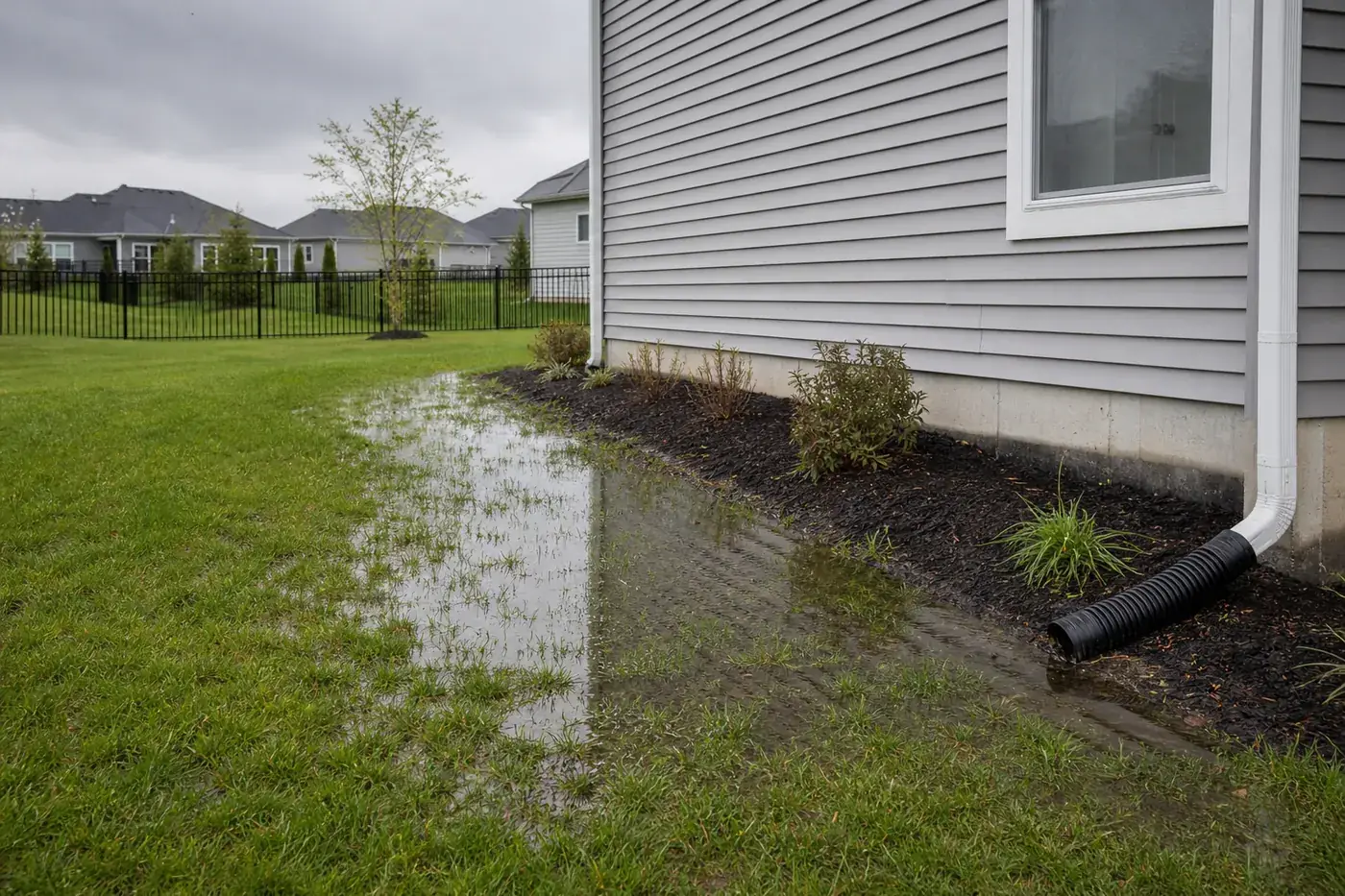
Central Indiana lies on the Tipton Till Plain: flat to gently rolling land over glacial till, an unsorted mix of everything from clay to boulders (Indiana Geological & Water Survey). Crosby soil formed in up to 22 inches of windblown silt over loamy till, with dense till not far below (USDA). Water that soaks in has little room to go down, so it spreads sideways and sits.
The soils in the sample
- Brookston (19 of 49 points): poorly drained and found in depressions. In normal years its water table ranges from half a foot above the surface to a foot below it.
- Crosby (19 points): somewhat poorly drained, with a perched water table 0.5 to 2 feet down in winter and spring.
- Miami (7 points): moderately well drained; its perched water table sits 2 to 3 feet down from December to April.
- Shoals (3 points): somewhat poorly drained.
Source: USDA NRCS soil survey data and official soil series descriptions.
Why swelling clay isn't the main story
In places like Texas, clay that swells and shrinks with the seasons drives foundation damage. In Hamilton County, 96.6% of the major soils rate moderate for shrink-swell, and effectively none rate high (USDA). Here, the water table does more of the work: saturated backfill presses on basement walls, soft wet spots let footings and slabs settle, and water finds cracks.
Frost, footings and the slabs that move
Indiana's residential code sets the minimum footing depth for Hamilton County at 30 inches, measured from finish grade to the bottom of the footing (Indiana Administrative Code, Table R301.2(1)). That keeps a house's footings below normal frost. The parts of a lot that are not on footings are a different story. Front stoops, walks, patios and many garage aprons rest near the surface, and on Brookston or Crosby ground that surface soil is often wet when it freezes. Wet soil that freezes expands, then softens again in the thaw, so these slabs lift, tilt and drop a little more each winter. A sunken stoop that pitches water back toward the wall is one of the most common things a Westfield inspection finds, and it is a drainage problem before it is a foundation one.
What to do on a wet-soil lot
- Keep the ground sloping away from the house as backfill settles.
- Run downspouts well away from the foundation.
- Test the sump before spring, when water tables are highest.
- Watch for new cracks or dropped slabs after long wet spells.
If you see movement, read about house leveling in Westfield or foundation crack repair, and check typical foundation repair costs in Westfield.
Ask for a Westfield foundation inspection
Describe what you've noticed. An independent foundation specialist who works in Westfield will phone you to pick a time.